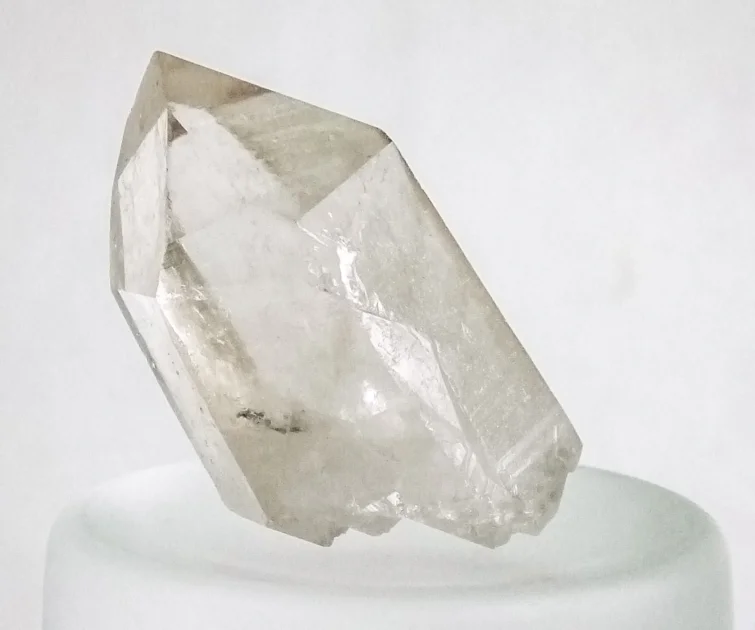

In crystal traditions, clear quartz is often regarded as a versatile healing stone, a pure light said to balance energy on every level.
Principal SourcesBrazil, the United States, Madagascar, India, China, and elsewhere
When to Use★ At any time
★ To develop spiritual awareness or divination skills ★ To strengthen one's energy field against outside influences
UsesStudy and personal growth
Body CorrespondenceWhole body (all seven chakras)
Chakras
Chinese ZodiacDragon and all Chinese zodiac signs
Zodiac SignGemini and all zodiac signs
MBTIIN and NT groups
CleansingAny cleansing method
When quartz forms clear, attractive six-sided prisms, it is called rock crystal. Some crystal traditions associate its trigonal structure with a distinct kind of energy. Legend holds that Lemuria and Atlantis used crystal to guide spiritual awakening. In stories about ancient Greece, rock crystal was seen as an embodiment of the Castalian Spring and a symbol of an unspoiled cosmic source. Pure rock crystal is traditionally regarded as the king of crystals.
Original banner crop for reference
Rock Crystal
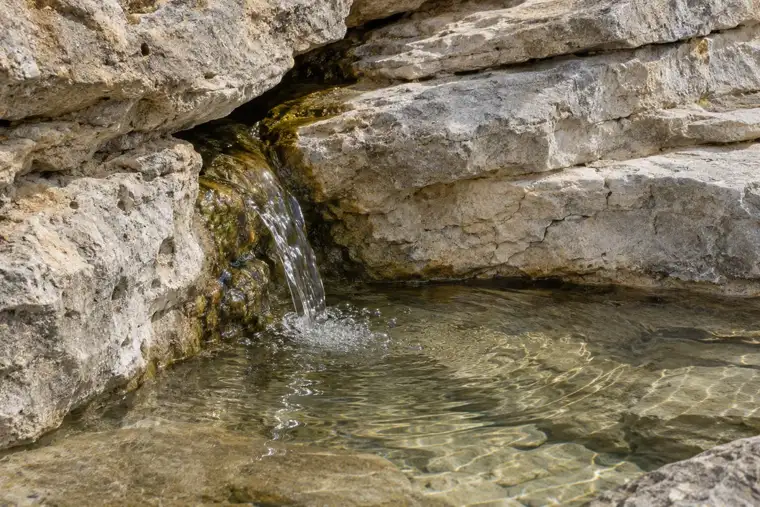
The ancient Greeks saw clear quartz as the embodiment of the Castalian Spring.
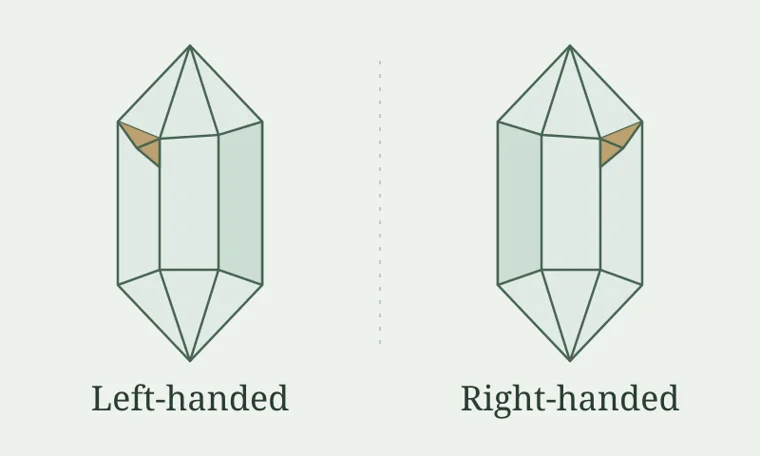
Ideal quartz crystal forms showing left- and right-handed varieties.
Basic Information
Quartz consists primarily of silicon dioxide (SiO₂). One estimate puts it at about 12% of the lithosphere, second to feldspar. Quartz is also described as the most abundant silicate mineral in the crust. Here, rock crystal refers to the transparent, colorless variety of crystalline quartz.
Rock crystal naturally forms six-sided prisms. Its name derives from the Greek κρύσταλλος, often rendered as “icy crystal”. People once believed it was water frozen forever by divine powers. In On Stones, the Greek philosopher Theophrastus described it as ice permanently frozen by extreme cold. The Roman naturalist Pliny the Elder also wrote about this belief, taking quartz to be ice that had remained frozen for a long time because crystals were then often found in Alpine glaciers. The idea endured at least into the seventeenth century, a measure of how strongly the crystal's transparency shaped its image.
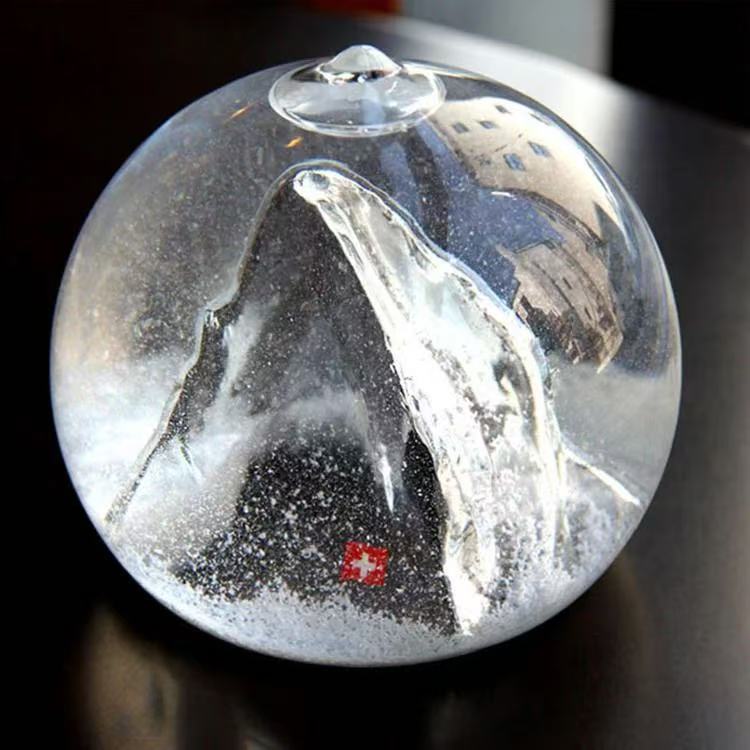
Rock crystal from the Swiss Alps.
Rock crystal was used in jewelry and carving as early as 6,000 years ago. In ancient Egypt, clear rock crystal was carved into amulets and scarabs that symbolized wisdom, purity, and eternity.
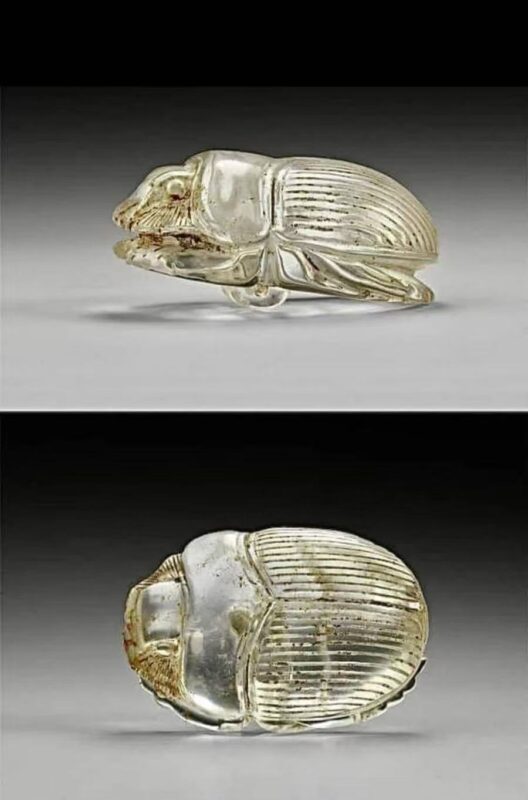
Ancient Egyptian scarab carved from rock crystal.
The references to fever and headache describe historical beliefs. For medical guidance, consult a qualified healthcare professional.
Rock crystal was also used in early healing traditions. In accounts of ancient Greek beliefs, pure rock crystal was seen as the embodiment of the Castalian Spring, and both were credited with extraordinary healing powers. Greek physicians were said to regard it as exceptional among stones and to associate it especially with relief from fever and headache.
From antiquity to the Middle Ages, wealthy families in Europe and the Arab world reportedly kept drinking water in vessels carved from rock crystal. They were said to believe that these vessels could turn ordinary water into sacred water blessed by the gods. This may have been an early form of what is now called a crystal elixir.
A ninth-century Arabian rock crystal vessel and a sixteenth-century Milanese example.
Rock Crystal
Physical Characteristics
Brazilian clear quartz cluster.
The outward form a crystal tends to develop is known in mineralogy as its crystal habit. The eight forms below illustrate different habits associated with rock crystal.
a. Normal habit. The most common natural form combines a six-sided prism with a hexagonal bipyramid. Its prism faces show clear horizontal striations, and its tip is well formed. Brazilian specimens are typical examples.
b. Trigonal habit. This form has been described as an outward expression of low-temperature quartz’s crystal system. It resembles a triangular prism, with only three main faces at the termination. It is said to be rare and found chiefly in the Alps and Japan.
c. Hexagonal habit. This nearly ideal six-sided prism has sides perpendicular to the base, a symmetrical termination, few horizontal striations, and high transparency. It is often mistaken for synthetic quartz.
d. Pseudohexagonal habit. One proposed explanation is that this shape results from superimposed Dauphiné or Japan twins. At some angles it resembles a perfect six-sided prism, but a close look at the termination or sides reveals a twin boundary.
e. Pseudocubic habit. Some faces develop unusually, giving the crystal the appearance of a cube or a rhombic dodecahedron. It is very rare and is occasionally found in the Swiss Alps.
f. Dauphiné habit. This form has been described as two intergrown individuals at a rotation of 30°, an angle that warrants verification. The six-sided outline is retained, while the termination or prism faces may appear doubled or joined. Donghai in China and Brazil have been cited as common sources.
g. Tapered habit. The crystal narrows from the base toward the tip, or is broader in the middle and narrower at both ends. In crystal collecting, this shape is sometimes associated with Lemurian quartz.
h. Muzo habit. This form is associated with the Muzo emerald district in Colombia. The crystals are described as very slender, with fine, closely spaced horizontal striations and sharp tips, features also associated with specimens called laser wand quartz.
a Normal Habit
b Trigonal Habit
c Hexagonal Habit
f Dauphine Habit
g Tapered Habit
h Muzo Habit
e Pseudocubic Habit
d Pseudohexagonal Habit
Muzo-habit quartz, described as a laser wand or “scalpel” crystal.
Rock Crystal
Physical Characteristics
Lemurian Quartz
Legend holds that the lost civilizations of Lemuria and Atlantis used crystals to record information and guide spiritual awakening.
Quartz occurs in two forms discussed here: alpha quartz at ordinary temperatures and beta quartz, which is stable at high temperatures. The transition occurs at 573°C, changing the crystal symmetry from trigonal to hexagonal. The quartz crystals we usually encounter are alpha quartz.
One explanation links quartz’s supposed ability to record information and its piezoelectric behavior to its technological uses. In this account, an electric current is said to enter one end of the crystal and leave the other. Greater input energy is said to increase the amplitude of vibrations within the crystal until it visibly expands. The proposed explanation is that changes in the distances between vibrating atoms add up at sufficiently large amplitudes and increase the crystal’s volume. This explanation is unverified.
Rock crystal has been claimed to have the most stable vibration frequency of any mineral, an unverified comparison. The proposed explanation is that its regular trigonal structure keeps interatomic distances and bond angles relatively fixed. Imagine people standing in an orderly formation whose positions let them respond consistently to a disturbance. By comparison, other minerals may have more complex structures or more defects. In a polycrystalline aggregate, for instance, differently oriented grains are thought in this explanation to interfere with one another’s vibrations when exposed to external energy. A single quartz crystal is offered as the contrasting case.
In crystal traditions, rock crystal has been credited with the following properties:
1. Focusing energy. It describes gathering energy that passes through a crystal and releasing it in one direction, citing lasers.
2. Storing information. It describes recording information through positive and negative charges, citing computers.
3. Transmitting information. It cites telephones as an example of using quartz's stable oscillation frequency.
4. Converting energy. It cites solar power generation as an example of changing energy from one form to another.
5. Amplifying energy. It describes increasing the energy that passes through a crystal, citing amplifiers.
It has been claimed that nearly all everyday electrical appliances use quartz to process information. This broad claim is unverified. Some crystal-healing accounts draw a parallel between the technological uses of quartz and the central place of rock crystal in their practice.
Piezoelectric Effect
Charge / +Q / −Q / dielectric / electric field E / plate area A / plate separation d
The Diverse Quartz Family
Beyond what is commonly called rock crystal, the quartz family includes many other groups. In crystal traditions, each is said to have strong healing energy.
Transparent crystals This group has well-formed, transparent crystals whose brilliance makes them widely sought after. Examples include clear quartz and amethyst.
Translucent quartz This massive, translucent quartz generally occurs as granular aggregates and has a soft, lustrous appearance. Examples include aventurine and rose quartz.
Translucent cryptocrystalline quartz Its crystal structure is too fine to see without a microscope. It has a fine texture and comes in many colors. Examples include agate and chalcedony.
Opaque cryptocrystalline quartz Abundant impurities can reduce transparency while leaving strong colors. Examples include tiger's eye and jasper.
Energy Characteristics
In some crystal traditions, rock crystal is regarded as a healing stone whose trigonal structure is said to concentrate energy and release it in strong, direct waves. Some accounts draw a parallel between this unverified idea, the industrial and technological uses of quartz, and the place of rock crystal in energy-healing practices.
In some alternative healing and spiritual traditions, practitioners use rock crystal when setting an intention. Its influence is said to be direct and is believed to help bring wishes to fruition.
Rock crystal contains silicon, one of the most abundant elements on Earth. Some crystal traditions associate silicon with a resonance with the Earth and with restoring energy. In these traditions, crystal is also said to bring harmony and holistic healing to those who seek greater peace and balance.
14 / 3s² 3p² / Si / Silicon / 28.086
How It Is Used
Energy fields, healing and chakras are discussed here as spiritual beliefs. Claims of effects on the body remain unverified.
Some crystal practitioners use rock crystal during meditation or quiet sitting. In this practice, the crystal is believed to have a steady, high frequency that raises the vibration of what practitioners call the body’s biomagnetic energy field, helping it regain stability and gradually restore balance. Rock crystal is also regarded as a versatile healing stone and is sometimes used to set an intention in the hope of bringing a goal to fruition. When working with another person, practitioners are said to use it to encourage clarity or place it on the chakras, where it is believed to clear and connect the energy between them.
In some energy-healing theories, a biomagnetic field is regarded as one form of human energy. Contact with crystal during meditation is likened to connecting an unstable, lower-frequency system—the body’s purported biomagnetic field—to a stable high-frequency source, the crystal. The field is said to come back into balance like an out-of-tune instrument resonating with a reference pitch. Once its frequency is believed to have stabilized, circulation and repair are said to begin, an analogy with the body’s natural healing process at an energetic level.
In this analogy, a lively, high-frequency energetic state is likened to fresh blood that “washes away” traces of injury. The structure and function of the energy field are said to recover gradually, much as the analogy pictures a wound healing with good circulation.
In energy healing and spiritual practice, setting an intention is considered important, and crystals are viewed as amplifiers and conductors of energy. Practitioners believe a crystal can receive and store the energy or information of an intention, then guide surrounding energy toward making that intention a reality. For example, someone seeking career success might place that intention in a crystal and carry it or keep it nearby, believing the crystal can continue to influence their energy field and attract opportunities or inspiration.
When practitioners work with others, crystal is believed to bring clarity through what they regard as its pure, stable energy. Like light reaching into a dark corner, it is said to reach through confusion or negativity in another person’s energy field and bring calm and clarity. Some practitioners believe the two fields interact, untangling energy lines so energy can flow more freely.
Special “High-Energy” Clear Quartz Specimens
Herkimer quartz
Brahma Azeztulite [name pending confirmation]
Isis Goddess quartz [name pending confirmation]
Himalayan quartz
Lemurian quartz
Chakra Associations
Placing clear quartz on the chakras to clear and connect their energy is a practice based on chakra theory. In this tradition, chakras are seen as important centers of human energy, and balance and flow between them are considered essential to well-being.
Clear quartz is believed to purify and balance energy. When placed on a chakra, it is said to absorb negative energy like a sponge absorbs water. It is also described as a bridge connecting the chakras so that energy can flow through the entire system, much as wires connect points in a circuit.
In chakra traditions, clear quartz is associated with all chakras and is sometimes called a versatile healing stone. Its transparent, flawless form is believed to admit many colors and kinds of light and emit a range of frequencies that offer support.
In some chakra practices, rock crystal is said to clear negative energy, maintain a stable, positive frequency, and strengthen each chakra’s existing qualities so it can perform its own function. A crystal’s energy is also believed to vary with its shape and color. Practitioners therefore often choose a crystal to suit the individual, believing that different crystals have different strengths in healing.
Individual image crops for replacement
Symbolic associations are cultural interpretations, not measured mineral properties or medical claims.